What Happens at a Leadership Retreat? A Day-by-Day Mindfulness Example
Three days in Victoria's spa country, phones away, small breakouts and a 90-day plan. Here's how a leadership mindfulness retreat runs, hour by hour.
What happens at a leadership retreat is simpler than most brochures suggest. You leave the office, slow down, do focused work on how you lead, then plan what changes on Monday. Michael Abdallah runs multi-day Leadership & Mindfulness Retreats from Melbourne, and below is a day-by-day example of how one unfolds.
Key Takeaways
A leadership mindfulness retreat moves through three phases: arrive and slow down, do the deep work, then turn insight into commitments.
Small groups work better, and breakouts of six or seven keep everyone in the conversation.
From Melbourne, spa country around Daylesford is one to two hours by car, close enough to arrive for lunch.
A retreat is not burnout treatment, and the gains fade unless you plan for Monday before you leave.
What Happens at a Leadership Retreat, in Short?
What happens at a leadership retreat is a planned shift from doing to thinking, held over several days away from the office. The first day lowers the noise. The middle day carries the hardest conversations and the most practice. The last day locks in decisions people will act on.
A mindfulness retreat differs from a strategy offsite in where the attention goes. A strategy offsite spends most hours on plans and numbers. Our retreats combine mindfulness, physical wellness and leadership workshops, so as much time goes to the leader as to the plan: attention, breath, sleep and how you respond under pressure.
The example below is a three-day format we use to show the shape of a retreat. Exact timings, venues and group sizes change with each cohort [CONFIRM: typical length in nights]. Before the days themselves, it helps to know who is in the room.
Who Is in the Room, and How Big Is the Group?
A leadership mindfulness retreat works best with a small group, because everyone needs airtime once the conversation gets personal. Research from Bain & Company found that once a decision group passes seven people, each extra member cuts decision effectiveness by about 10%. Groups of 17 or more rarely decide anything.
That is why we plan small cohorts and split them into breakouts of six or seven [CONFIRM: typical cohort size]. A mixed group might include founders, senior managers and a few people who manage no one but carry a lot of pressure. Colleagues sometimes attend together, and some companies ask about a private retreat for their own leaders [CONFIRM: private team retreats offered].
Small numbers also make psychological safety easier. People say what they think when the circle is ten, not forty, and the facilitator can notice who has gone quiet. Who you sit with shapes what happens at a leadership retreat as much as the agenda does.
Where Do Corporate Retreats From Melbourne Usually Go?
Corporate retreats from Melbourne often head north-west to spa country around Daylesford and the Macedon Ranges, a drive of one to two hours according to Tourism Australia. That is close enough to leave after a late breakfast, and far enough that nobody pops back to the office.
The region is called spa country for its natural mineral springs and spa retreats, which suit a slower pace. The Mornington Peninsula and the Yarra Valley are other regions within driving distance of the city, each with its own mix of coast, vineyards and walking tracks.
We hold retreats at carefully selected venues across Australia, and the set-up matters more than the postcode. Look for private rooms, a meeting space with daylight, walking paths from the door and Wi-Fi weak enough that switching off feels natural [CONFIRM: regions or venues we can name]. With the place sorted, here is how the days run.
Day One: How Do You Arrive and Slow Down?
Day one of a leadership retreat is about decompression, not content. Most people arrive with a full inbox still running in their head, so the afternoon stays light: check in, a short welcome circle and a walk before dinner.
Phones go into a box after the welcome, and an emergency number for the venue is shared with families and the office. Each person then writes one sentence on why they came and one thing they want to stop doing. Those notes come back out on the last day.
Dinner is simple and early. The evening ends with a 20-minute guided wind-down rather than a late night at the bar, because the aim is a full night's sleep before the busiest day of the retreat.
Day Two: What Does a Full Retreat Day Look Like?
Day two is the full working day of a leadership mindfulness retreat, and most of what happens at a leadership retreat happens here. It alternates between practice, workshop and rest. A sample timetable looks like this:
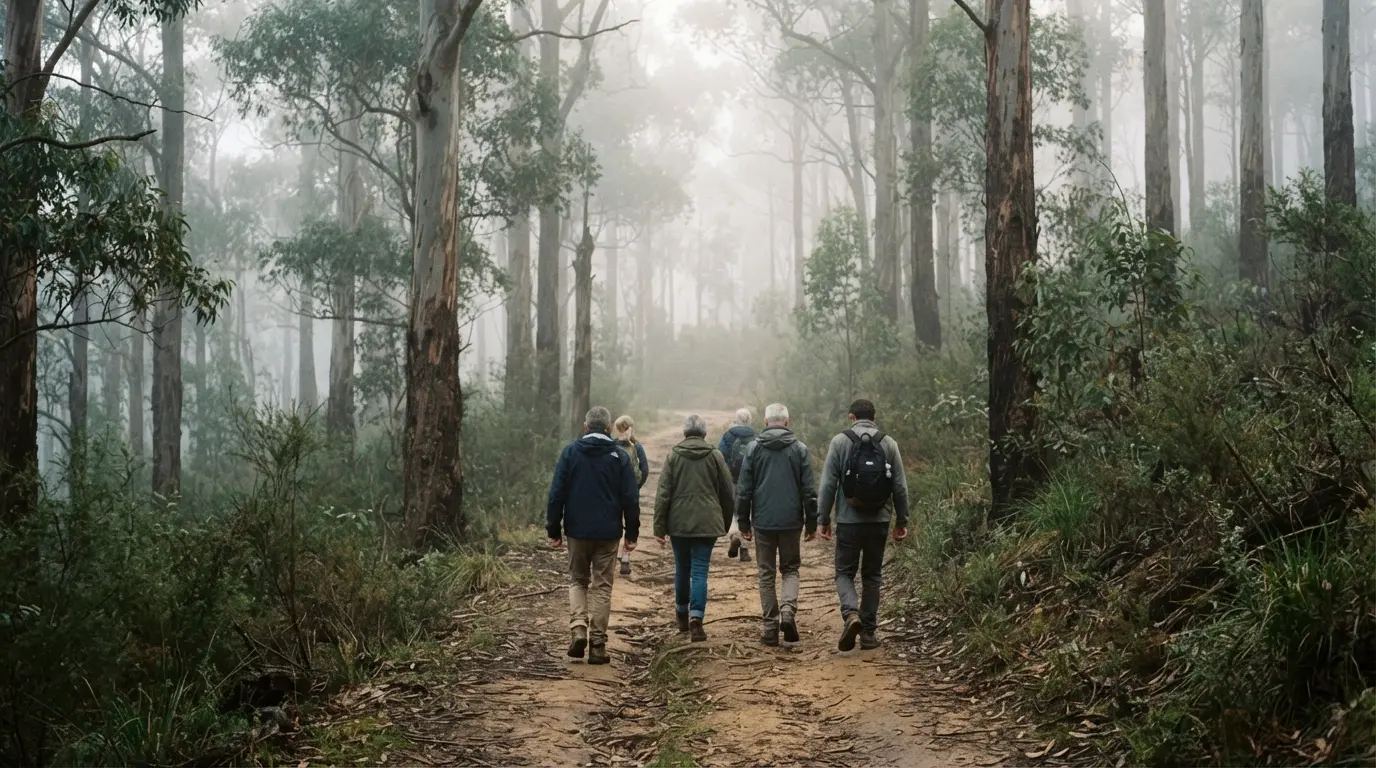
6.45am: Optional sunrise walk on a bush track
7.30am: Breathwork and seated mindfulness practice, 30 minutes
8.15am: Breakfast, still phone-free
9.15am: Workshop one, on how you react under pressure, with breakout sessions of six or seven
11.30am: Solo walk and journalling on one question from the workshop
12.30pm: Lunch
2.00pm: Workshop two, where each leader rehearses a hard conversation they have been avoiding, in pairs
4.00pm: Free time for a mineral bath, a nap or a book
6.30pm: Dinner, then a fireside reflection circle
The rhythm matters as much as the content, and it helps to know what a few device-free days can do. One PLOS ONE study of 56 adults on wilderness trips found that four days in nature without electronic devices lifted scores on a creative problem-solving task by 50%.
Workshops stay practical. Rather than lectures on leadership theory, each session ends with a choice: one habit to try, one conversation to have, or one decision to make. Those choices become the raw material for the final day.
Day Three: How Do Insights Become Commitments?
Day three turns what people noticed into commitments they can keep. The morning practice is shorter, and the main session is a 90-day plan built around three changes rather than ten.
Each person pairs with an accountability partner, ideally from a different organisation, and books the first check-in before leaving. The notes from day one come back out, and people compare what they wanted to stop with what they have now committed to.
The retreat closes after lunch so people get home before dark. Slowing down for a few days can also show people how tired they were, which raises a fair question about burnout.
Is a Burnout Retreat in Australia the Same Thing?
A burnout retreat in Australia and a leadership retreat can look alike, but neither is medical treatment. The World Health Organization describes burn-out as a syndrome from chronic workplace stress that has not been successfully managed. Its signs are exhaustion, mental distance from the job and reduced professional efficacy, and it is classed as an occupational phenomenon, not a medical condition.
Work pressure is a real driver. Safe Work Australia reports that work pressure caused 25.2% of serious mental stress claims in 2021-22. In 2020-21, a serious mental health claim meant a median 34.2 weeks off work, against 8 weeks for all claims.
A retreat can give you rest and a few new habits, but it does not replace a GP or psychologist. If you are struggling to get through the week, start there. Treat a retreat as one support among several, not the whole answer.
What Do People Take Back to Work?
People take back a written plan and a clearer sense of how they lead under pressure. Keeping it is the hard part, since a meta-analysis of vacation studies found that health and well-being gains from time off soon fade once work resumes.
That is why the last day is built around Monday. Leaders leave with a five-minute morning practice, one meeting rule such as no phones on the table, and a date for their first partner check-in. For the business case, read the ROI of executive retreats.
The habits are small on purpose, so they survive a busy week. In our view, the most useful part of what happens at a leadership retreat is what you still do a month later. For the science of switching off, see what retreats in Australia do for your brain and focus.
What Does a Leadership Retreat Cost?
The cost of a leadership retreat depends on the number of nights, the venue standard, what is included and how much one-on-one time each person gets. Executive retreats in Australia with private rooms, all meals and a facilitator for the whole stay sit at the higher end.
When comparing prices, check what the fee covers. Some quotes include the programme only and leave rooms, meals and travel to you, so a lower headline price can cost more once accommodation is added. Ask about cancellation terms, and whether the company can be invoiced directly.
Our own retreat fees and inclusions are [CONFIRM: per-person price range and inclusions]. Current dates and details are released through the Leadership & Mindfulness Retreats page.
Frequently Asked Questions
How long should a leadership retreat be?
Three days and two nights is a common shape, because the first evening is mostly decompression and the last morning is planning. Shorter formats suit strategy offsites, but a mindfulness retreat needs at least one full middle day where nothing is rushed. Longer stays allow more recovery time if diaries allow.
Do I need meditation experience to attend?
No. Practices start at a few minutes and build slowly, and you can sit out any session. Plenty of leaders have never meditated and prefer the walking and breathwork sessions to seated practice. If you have an injury or health condition, tell the facilitator beforehand so movement sessions can be adjusted for you.
Can a whole leadership team attend together?
Teams can attend together, though it changes the feel of the group. Colleagues tend to be more guarded in front of each other at first, so facilitators mix pairs across levels and keep some sessions individual. Larger teams sometimes split across two cohorts so everyone gets airtime. [CONFIRM: private team retreats offered]
Are phones banned for the whole retreat?
Phones are stored rather than banned. The format above sets phone-free blocks during sessions and meals, with a short window each evening for urgent messages. Families and the office get the venue's emergency number, so people can switch off without worrying that they will miss something serious at home.
Talk to Us About an Upcoming Retreat
Tell us about your role and what you want from a retreat, and we'll send dates and locations for the next one.
Button: Express Interest